Paper helicopter template
Handed out at the table, one per child who makes a helicopter
A4, mono, 1 side · the PDF
Make something light enough to fly, and put it into the airflow.
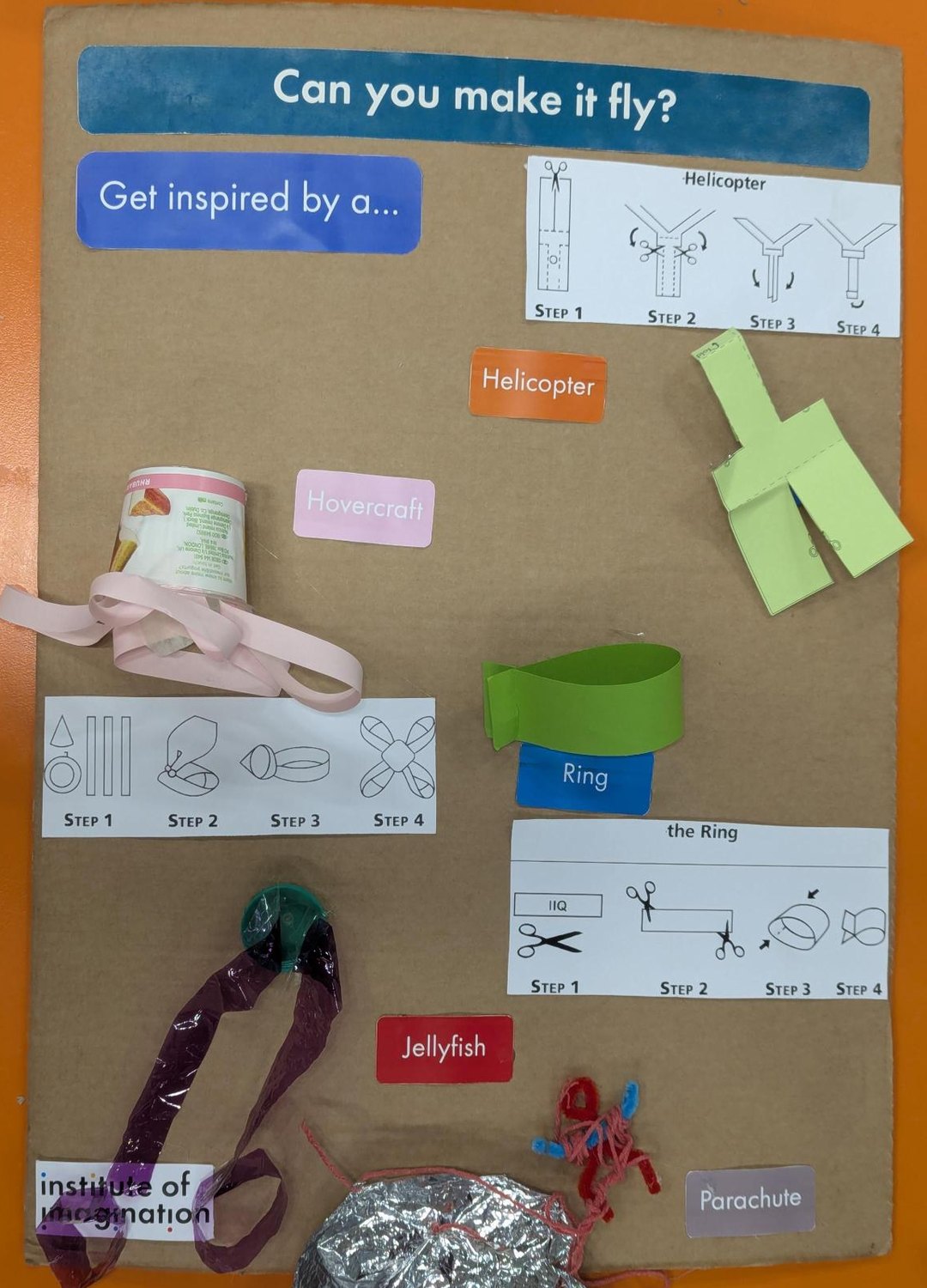
Children make a lightweight flyer and test it in the tunnel. The example board is headed Can you make it fly? and pins up five makes with the built object beside each label.
Nothing is finished until it has been in the airflow.
Two printed cutouts on the example board: a kingfisher and a bullet train.
The bird's beak enters water without a splash, and the train's nose was shaped to enter air the same way, to stop the bang heard at a tunnel mouth.
Printed A4, colour, one side.
The paper helicopter is a samara. It spins as it falls, and the spin slows the fall.
It is the one make here with a nature example a child can hold in the other hand.
Can you make it fly?
What in nature already flies like that?
Check the example board before the doors open, and rebuild it only if it is damaged. Click the photograph to enlarge it.
Handed out at the table, one per child who makes a helicopter
A4, mono, 1 side · the PDF
Above the station
A3, colour, 1 side
Five makes. A child picks one, and each is its own short build.
Balloons and straws are there for younger children.
The jellyfish needs a bottle cap, which a child fetches from the shared materials station.
The tunnel, with the mesh attached before the day. The fan repair kit travels with it: dowels, cable ties, a small hook and pliers.
The fan needs a socket. Where the tunnel stands is decided by where the socket is, not the other way round.
Three trays of strips before the doors open: cellophane, thick paper, thin paper. Refilled from stock through the day.
The helicopter template, A4 mono, one per child. The sign, A3 colour.
Offcuts cleared, scissors back in the pot, the trays topped up.
A flyer left in the airflow blocks it for the next child.
| Children handle | Scissors, children's scissors. Pipe cleaners, balloons, straws and paper cups are per child. |
|---|---|
| Adults handle | Glue guns, adult use only. Superglue, staff use only. |
| The fan | A factory chrome finger guard is fitted to the fan, and that is what protects fingers. A net sits on top of the guard, below the fan, mostly to stop cellophane and other light material being drawn into the blades. The top is not covered. Supervised at all times. It is mains and needs a socket, so the station has a trailing lead. |
| The airflow | Nothing is fired into the wind tunnel. Flyers are held in the airflow or let go into it by hand. |
| First aid | Cuts, from the children's scissors. The first aid pack is at the tool area. |